
Linkpool vs WhitePress: Which Backlink Marketplace Fits Your Campaign?
Linkpool and WhitePress both connect backlink buyers with publishers, but the practical comparison is not simply which marketplace has more sites. A useful decision looks at campaign brief quality, inventory relevance, publisher transparency, editorial approval, placement types, communication, live verification, monitoring and the records a team must maintain after publication.
Linkpool is a backlink marketplace designed to organize placement discovery and transactions between advertisers and publishers. WhitePress describes a broader content-marketing and link-building platform for agencies, marketers and publishers, with sponsored articles and options that may include links in existing articles or other publisher offers. Current availability and terms should be checked inside each live platform.
Neither marketplace can guarantee rankings or make an unsuitable link useful. Search performance depends on many factors outside a placement. The buyer remains responsible for destination quality, the publisher remains responsible for editorial standards, and both sides should verify exactly what went live.
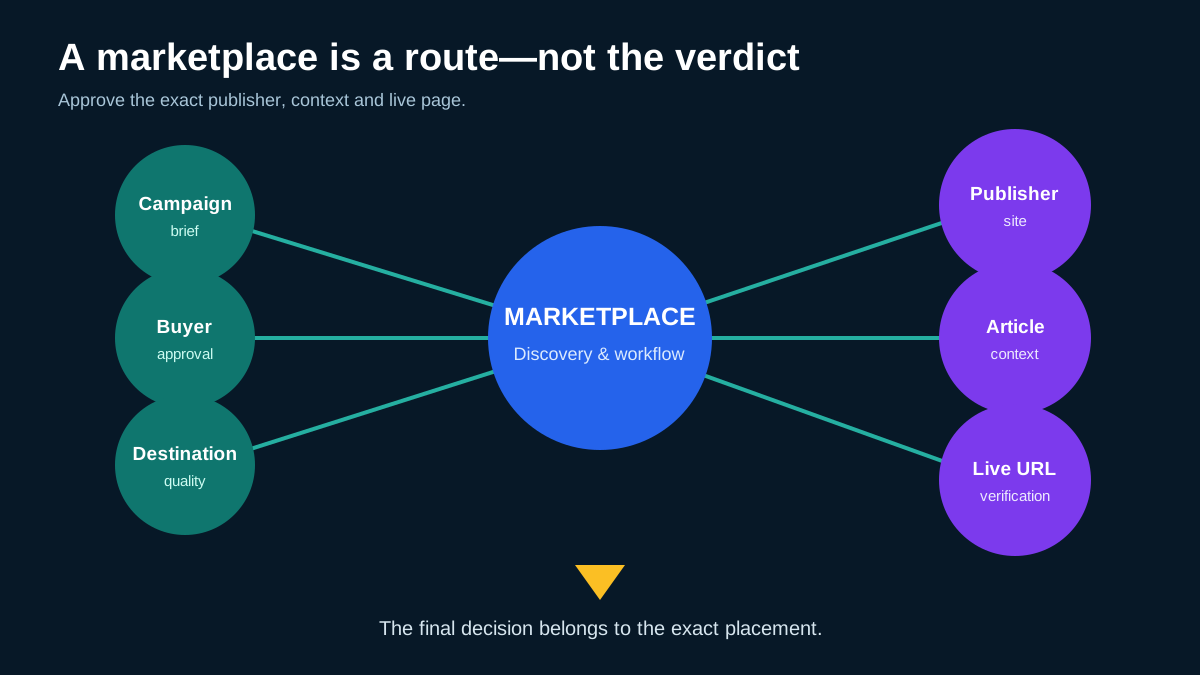
Compare the complete placement lifecycle, not only the size of a catalog.
Quick answer
Choose Linkpool when you want a focused marketplace workflow and its available publishers, filters, commercial terms and approval route fit your campaign. Choose WhitePress when its broader international platform, content services or specific placement formats fit the markets and operating model you need.
For either option, begin with a written brief and a small pilot. Review the actual site, article, proposed context, anchor, destination, disclosure and price before approving. After publication, open the live URL, record the result and monitor the placement according to the agreement.
The guide to how contextual link placements work explains the difference between discovering an opportunity and approving the final editorial context.
Compare campaign fit before marketplace size
A large inventory is not automatically a relevant inventory. Define the audience, language, country, topic, acceptable site types, excluded categories, destination page, disclosure requirements and budget. Then evaluate how easily each marketplace helps you find and validate candidates that match those constraints.
Count qualified opportunities after review, not the total number shown in marketing. A small set of genuinely relevant publishers can be more operationally useful than thousands of entries that require repeated rejection.
Record why each candidate passed or failed. This creates reusable exclusion rules and stops different team members from reviewing the same unsuitable sites every month.
Linkpool: fit for a focused marketplace process
Linkpool's practical value should be judged through its live inventory and workflow. Test how clearly the platform presents publisher information, commercial terms, placement expectations and the steps between order, editorial work and completion.
A focused workflow can help an agency or in-house team keep discovery, negotiation and status tracking in one place. The marketplace is still not a substitute for opening the site. Review recent posts, authorship, topic consistency, outbound-link patterns, audience relevance and whether the proposed article would add something useful.
Use a pilot that represents your real campaign. Avoid choosing an unusually easy topic solely to make the platform test look successful.
WhitePress: fit for a broader content-marketing platform
WhitePress presents itself as an international content-marketing and link-building platform connecting advertisers with publishers. Its official materials describe sponsored article publication and publisher offers that can include links added to existing articles, sitewide placements or banners, depending on what is available.
That wider menu may suit agencies operating across several markets or teams that want content-related services in the same platform. It also requires clear internal rules. Sponsored articles, existing-content insertions and sitewide links have different editorial contexts, review questions and risk profiles.
Confirm the current platform terms, market coverage, publisher data, service boundaries and cancellation or correction process. Do not infer that a format is suitable merely because it can be ordered.
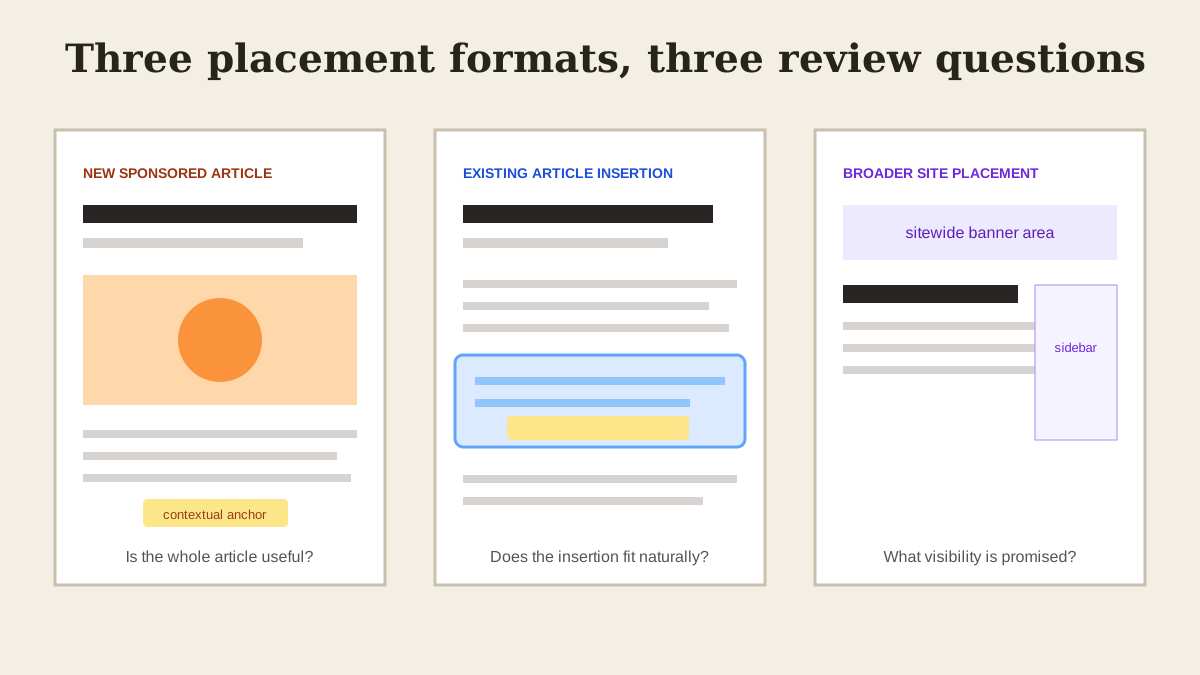
Treat every placement format as a different editorial decision.
Publisher review and transparency
Before comparing prices, select five representative publishers from each platform and review them manually. Check whether the site has a clear purpose, stable navigation, identifiable ownership or contact information, coherent authorship and recent articles written for readers rather than for links alone.
Read several pages, including content that does not contain an obvious commercial link. Look for consistent quality, sensible internal linking and a real editorial topic. A site that covers unrelated industries in rapid succession may not be a good fit even if a metric looks attractive.
Marketplace metrics can be useful screening signals, but verify their meaning, source and freshness. Do not treat a third-party authority score as a promise of traffic, indexing or ranking impact.
Brief, anchor and destination controls
Build the same brief in both platforms. State the audience question, subject boundaries, factual sources, prohibited claims, preferred destination, acceptable anchor language, disclosure requirement and approval stages. Keep the brief useful enough to guide an editor without forcing unnatural wording.
The final anchor should describe the destination accurately inside the sentence. Exact-match phrasing can become awkward or misleading when it dictates the article. Review the paragraph, anchor and landing page together with the contextual anchor-text workflow.
Open the destination while signed out. Confirm that it works in the target market, matches the anchor, loads securely and does not introduce an unexpected payment or registration gate.
Content approval and editorial independence
Clarify whether the buyer supplies a draft, the publisher writes it, or the platform coordinates writing. Then identify who checks factual accuracy, legal or compliance concerns, brand claims, originality, images, links and disclosure before publication.
A publisher should retain the ability to edit for accuracy and reader value. A buyer should be able to reject invented claims or a context that misrepresents the destination. The approval process should record changes rather than rely on scattered messages.
Use the contextual placement approval checklist to review the actual page rather than approving only a headline or domain.
Pricing and total campaign cost
Compare the price of a qualified, approved and verified placement—not the lowest catalog entry. Include marketplace fees, writing, translation, image licensing, revisions, staff review, payment costs and the work of monitoring after publication.
Different currencies, tax treatment or agency billing structures can change the effective cost. Capture the date, amount, currency and what the order includes. If permanence or a minimum live period is part of the offer, save that term with the order record.
Do not calculate return from a ranking promise. Define observable operational outcomes: a relevant placement published as approved, a referral path that works, brand exposure to the intended audience and a record that can be audited.
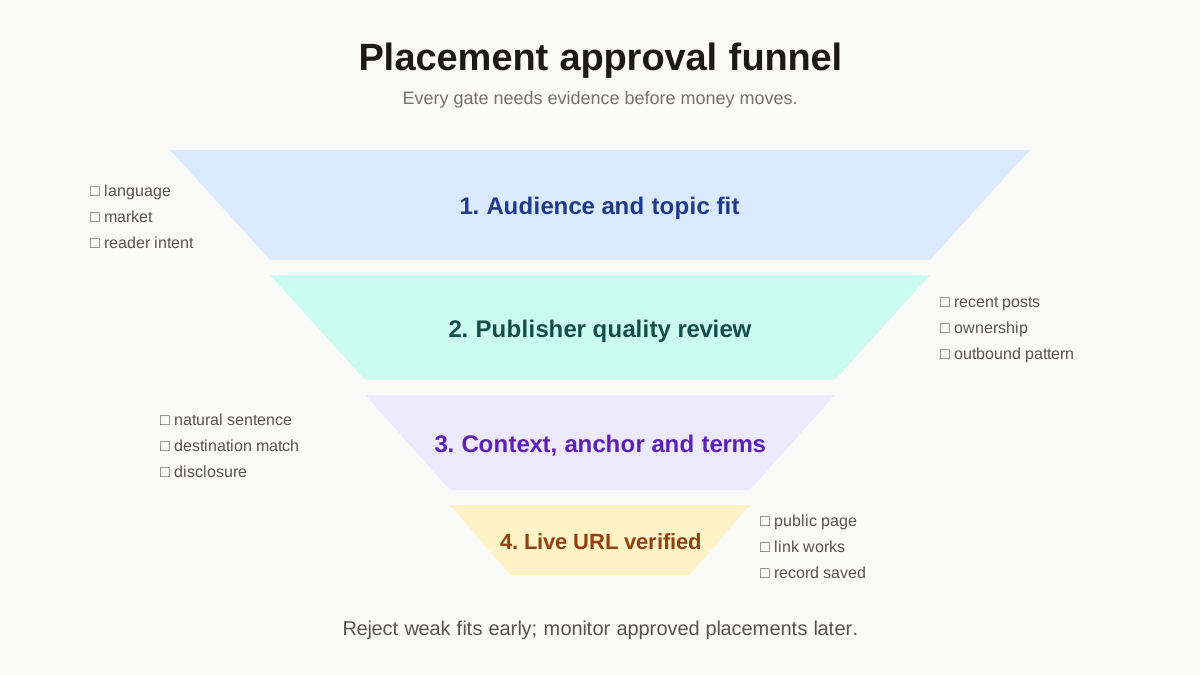
Score only evidence you can inspect and work your team can maintain.
Publication verification
When the order is marked complete, open the public article instead of trusting a status label. Check the canonical URL, HTTP response, indexability signals, title, article body, disclosure, anchor, destination, rel attributes, mobile layout and publication date.
Take a timestamped record and note any redirect between the submitted and final URL. If the page differs from the approved version, contact the publisher through the documented route and keep the placement open until the discrepancy is resolved.
A draft, preview or screenshot is not a live placement. Count it only after the public URL is accessible and the link works as agreed.
Monitoring and change handling
Decide the monitoring cadence before buying. A high-value placement may warrant checks after one day, one week and monthly thereafter. A larger portfolio may use automated response and content checks with manual review of exceptions.
Track removal, destination changes, anchor edits, rel-attribute changes, canonical changes, noindex directives and material revisions to the surrounding article. Not every change is a breach; compare it with the recorded agreement and publisher policy.
The post-publication monitoring guide provides a practical record for verifying the page without assuming it will remain unchanged forever.
A fair two-platform pilot
Use the same campaign brief, destination type, language, market and budget range. Shortlist at least three candidates on each platform. Record review time, rejection reasons, available evidence and the clarity of commercial terms.
Order only placements that independently pass review. Measure communication, approval visibility, revision handling, time to publication, live accuracy and issue resolution. Do not force equal order counts when one platform lacks a qualified match.
At the end, compare qualified inventory, editorial confidence, staff time, total cost and monitoring requirements. Preserve the notes so the next campaign begins with evidence rather than memory.
Final recommendation
Linkpool is the stronger candidate when its focused marketplace workflow and live publisher opportunities match the campaign. WhitePress is the stronger candidate when a team benefits from its broader international content-marketing platform or specific available placement formats.
The result may differ by country, language or niche. Many teams should evaluate at the campaign level rather than declaring one permanent winner. The platform is a route to a publisher; the final decision belongs to the exact site, article, context and agreement.
Start with a small pilot, reject weak fits, approve real pages and monitor what was published. That discipline matters more than a marketplace logo.
Frequently asked questions
Is Linkpool a WhitePress alternative?
Yes, for teams comparing marketplaces that connect advertisers and publishers. Their inventory, services, markets and workflows differ, so evaluate them with the same campaign brief.
Which marketplace has better publishers?
There is no universal answer. Review the live candidates available for your language, topic and audience, then assess recent content, editorial consistency, terms and the proposed placement.
Can a backlink marketplace guarantee rankings?
No responsible comparison should promise a ranking outcome. A marketplace can organize opportunities and transactions; search results depend on many factors outside one placement.
Should I choose a sponsored article or an existing-content insertion?
Choose based on reader value, editorial fit, publisher policy and campaign purpose. Review the complete context and disclosure; do not decide from price or anchor alone.