
Contextual Backlink Anchor Text: A Practical Review Workflow
Anchor text is the clickable wording of a link. In a contextual placement, it should help a reader understand what the destination provides and fit naturally inside the surrounding sentence. Review the source article, paragraph, anchor and landing page together; a keyword that looks attractive in a spreadsheet can still create a weak or misleading reference.
A backlink marketplace can organize placement opportunities and approvals between agencies and publishers. The editorial decision remains specific to the article and destination. This workflow helps both sides reach an anchor that is descriptive, accurate and readable without promising a ranking outcome.
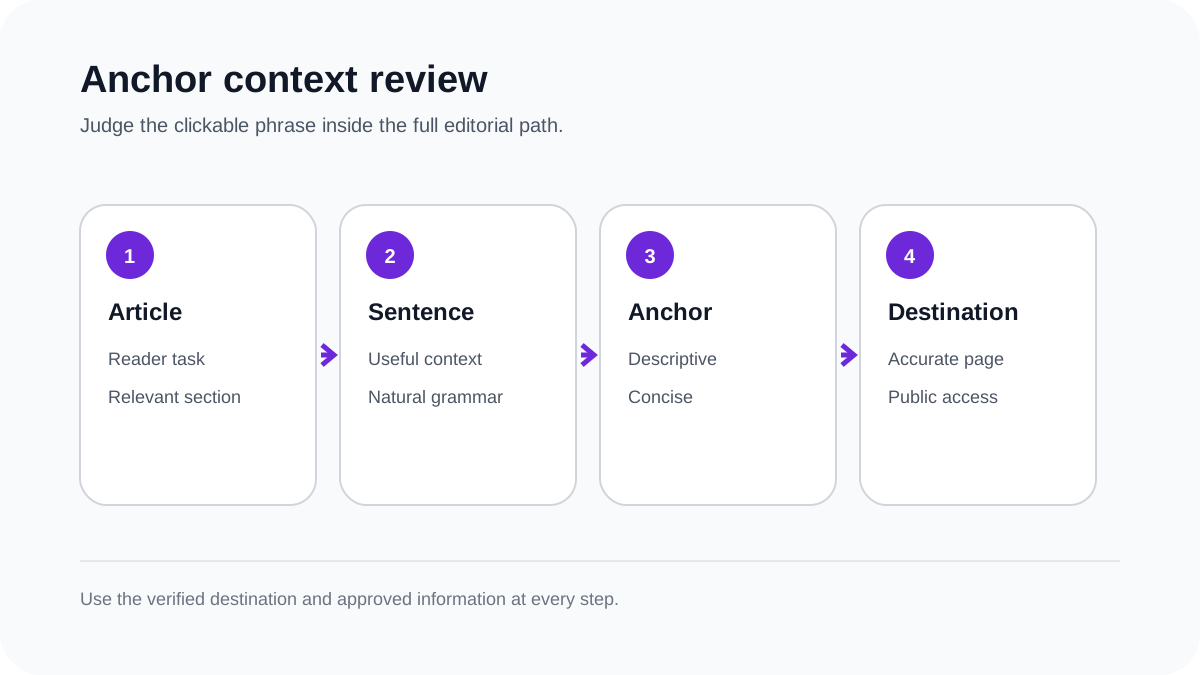
Judge the clickable phrase inside the complete source-to-destination path.
Begin with the reader's question
Read the section where the link would appear and identify what the reader is trying to understand. The anchor should support that task. If a paragraph compares restaurant menu workflows, a descriptive reference to a menu-building guide may help. A commercial phrase about unrelated software would not become relevant merely because the article mentions restaurants.
Write the sentence without a link first. It should contribute useful information on its own. Then identify the words that naturally describe the supporting destination. This prevents the link request from dictating an awkward sentence that the article did not need.
The contextual placement approval checklist begins with the same reader-fit test. Anchor review is one layer of that broader decision, not a substitute for reviewing article quality, destination value, evidence and commercial terms.
Open the final destination before choosing words
Follow the requested URL, including redirects, while signed out. Confirm the page title, main purpose, owner, access conditions and current content. The anchor should describe what a visitor receives now, not the advertiser's internal campaign label.
A phrase such as “pricing guide” should lead to a substantive pricing guide. “Free template” should not open a page that hides the resource behind an unexpected payment. If the destination is a homepage, use wording that fits the business or service rather than pretending it is a narrow guide.
Record the final URL in the approval note. If redirects or content change before publication, review the anchor again. A destination that changes purpose can make previously accurate wording misleading.
Classify the proposed anchor without treating categories as quotas
Useful working categories include brand name, page or resource title, descriptive partial phrase, ordinary contextual wording and the visible URL. These labels help a reviewer describe the proposal; they are not universal percentages that every campaign must reproduce.
Exact-match commercial wording can sometimes describe a destination accurately, but repeated use or a phrase that strains the sentence deserves closer review. Branded wording can be clear but too vague when the reader does not know what the brand provides. A natural descriptive phrase often communicates the destination best.
Do not manufacture variety by using meaningless text such as “this,” “here” or “website.” Variety should come from genuine editorial context. Different articles may refer to the same useful page in different accurate ways because the surrounding questions differ.
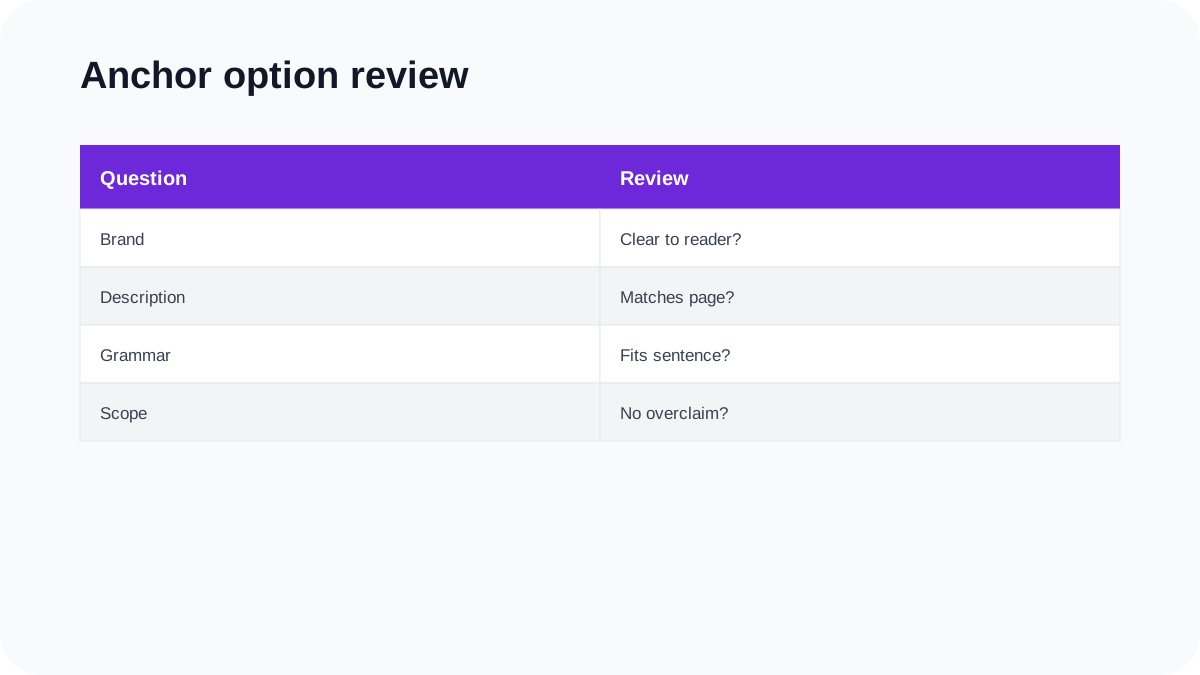
Use categories to discuss the wording, not to impose a mechanical ratio.
Read the complete paragraph aloud
The anchor should be grammatically integrated with the sentence. Read the sentence before and after it, then read the full paragraph aloud. Listen for sudden changes in tone, unnatural repetition and a phrase that sounds like an advertisement inserted into editorial copy.
Check whether the surrounding words explain why the destination is useful. A descriptive anchor cannot rescue a paragraph that provides no reason for the reference. Conversely, a concise anchor can work well when the sentence establishes the destination clearly.
Remove the hyperlink formatting and read the text again. If the sentence becomes confusing or promotional without the visual cue, revise it. The article should remain useful to someone who does not follow the link.
Compare the wording with the destination's real scope
Avoid making the anchor broader than the page. A single checklist is not a “complete platform,” and a product homepage is not automatically an independent research report. Match the noun and qualifier to the actual resource.
Also avoid unsupported endorsements. “The best,” “guaranteed,” “trusted by everyone” and similar wording require evidence that an ordinary placement request rarely supplies. A neutral description can be useful without pretending the publisher independently tested or recommends every claim.
If the destination serves a particular geography, audience, format or version, decide whether that limitation matters in the sentence. Accuracy builds reader trust and makes later maintenance easier.
Check the relationship at four levels
Review topic fit between the publisher and destination, article fit between the source page and landing page, section fit where the link appears, and sentence fit around the anchor. A match at only one level is weak.
For example, two marketing sites may share a broad topic while the proposed source article and destination solve unrelated tasks. A highly relevant section inside an otherwise appropriate article provides a stronger editorial basis.
The guide explaining how contextual link placements work covers the full sequence from prospecting through verification. Anchor text should be chosen after a real placement opportunity exists, not used to justify a page selected only for its metric.
Use Google's published link guidance as a boundary
Google's link best-practices documentation recommends descriptive, reasonably concise anchor text and useful surrounding context. It also advises against forcing every word related to the target into the link.
For paid placements, review Google's separate guidance on qualifying outbound links and the publisher's disclosure policy. Anchor wording and link qualification answer different questions: one describes the destination, while the other helps communicate the commercial relationship.
Do not ask a publisher to remove appropriate sponsored treatment in exchange for payment. Editorial usefulness and transparent handling should remain part of the approval record.
Review anchors across the campaign without forcing a formula
Maintain a list of approved source URLs, destination URLs and anchors. Look for accidental repetition, copied sentences, irrelevant language and several placements that all use the same highly commercial wording.
The review is qualitative as well as numerical. Ten different phrases can still sound manipulated if every surrounding paragraph was built only to host a link. One repeated brand name can be entirely ordinary when several independent sources refer to that organization.
Use the campaign record to ask better questions: Does each source have a reason to cite the destination? Does the wording match the page? Would the paragraph remain useful without the commercial request? Do not promise that a particular distribution will produce a ranking result.
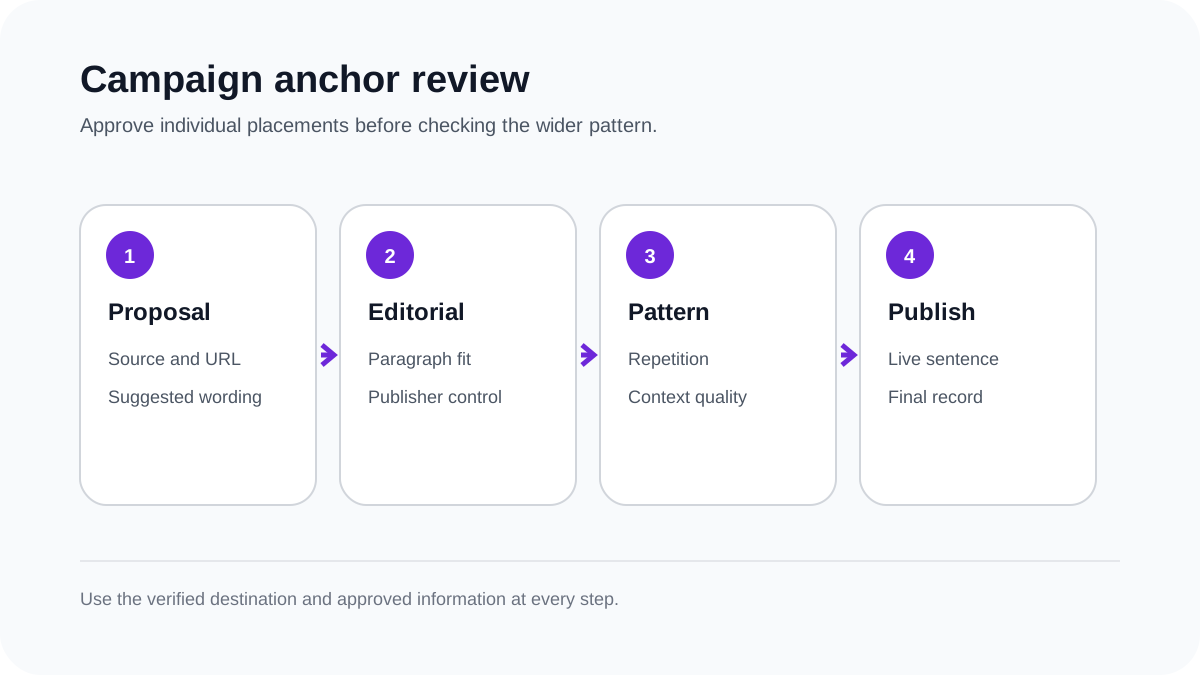
Approve each sentence first, then inspect the wider pattern for repetition and weak context.
Keep publisher edits visible
A publisher may improve the sentence to match house style or protect factual accuracy. Save the proposed and approved wording so both sides understand the change. If an edit materially changes the destination description, reopen the review instead of treating it as cosmetic.
Do not require an exact phrase when it makes the sentence worse. If the campaign depends on wording the publisher cannot use responsibly, choose a different opportunity or revise the landing page and brief.
The article on monitoring a live placement explains how to record the final sentence and destination after publication. The public version—not the draft screenshot—is the delivery that should be checked.
A compact approval record
Record the source URL, section heading, full proposed paragraph, anchor, requested destination, final destination after redirects, editorial rationale, commercial treatment, approver and date. Add the final public URL and verification result after publication.
Keep rejected proposals with a short reason such as inaccurate destination description, weak section fit, unsupported endorsement or duplicate wording. This helps the next reviewer avoid repeating the same problem.
A useful anchor-text process protects the reader, publisher and advertiser at the same time. It produces a clear reference that belongs in the article and remains understandable when someone reviews the placement later.
Frequently asked questions
Is exact-match anchor text always wrong?
No. It can accurately describe a destination, but it should fit the sentence and wider campaign naturally. Repetition, forced grammar and misleading scope are reasons to revise it.
Should every backlink use a different anchor?
Not mechanically. Use wording that accurately fits each editorial context. Review the wider pattern for unnecessary repetition without inventing meaningless variation.
Can a brand name be good anchor text?
Yes, especially when the sentence already explains what the organization or resource provides. Add useful context when the brand alone would be unclear to the reader.
Who should approve the final anchor?
The publisher retains editorial control over the source article, while the advertiser or agency confirms that the wording and URL describe the intended destination. Record the agreed public version before settlement.