
Backlink Marketplace vs Direct Outreach: Which Workflow Fits?
A backlink marketplace and direct email outreach can both connect an advertiser with a publisher, but they organize the work differently. Direct outreach gives the agency complete control over research, contact, negotiation and follow-up. A marketplace can centralize opportunities, price discussions, approvals, publication evidence and records between participating buyers and publishers.
Choose direct outreach when you have a small, carefully researched target list, a clear relationship reason and the capacity to manage replies. Choose a backlink marketplace when you want a structured place to review participating inventory and move suitable opportunities through an approval workflow. Neither method makes an irrelevant placement useful or guarantees a search result.
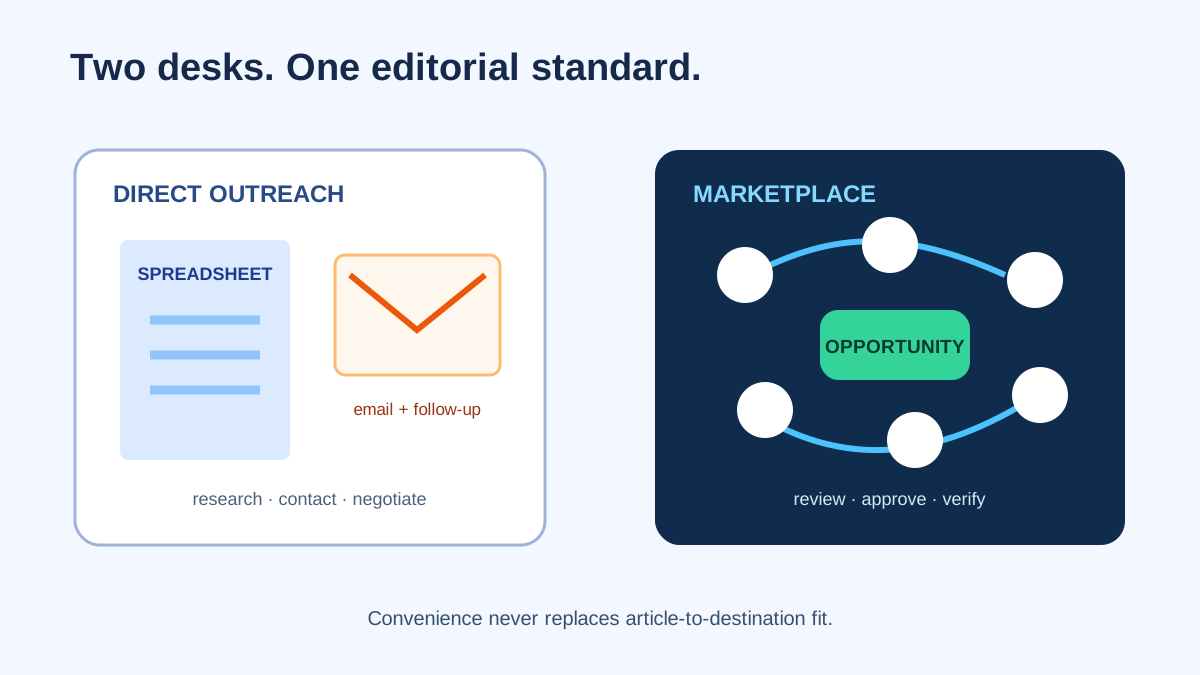
Compare the operating work, not only the number of websites available.
Quick comparison
Direct outreach begins with prospecting. The agency identifies publications, finds appropriate contacts, studies relevant pages, writes individualized messages, follows up and negotiates terms. This can build valuable relationships, but the sender also owns data quality, email deliverability and every record needed later.
A marketplace begins with publishers that have chosen to participate and describe available opportunities. The buyer can assess fit, evidence, price and terms inside a more consistent workflow. Supply is limited to the publishers present, and every opportunity still needs human editorial review.
The strongest choice depends on campaign scope, niche scarcity, relationship value, internal time and the quality of available evidence. Many teams use both: direct outreach for strategic publications and a marketplace for structured discovery and fulfilment.
Research quality comes before contact method
Start with the reader and destination. Define the audience, landing page, useful topics, excluded topics, geographic scope, budget and commercial treatment. A vague brief produces vague outreach and weak marketplace matches.
Read the proposed source article, not only the domain homepage. Check the section where a reference could belong, the destination after redirects and whether the sentence would help a reader. The contextual placement approval checklist provides a common test for either workflow.
Authority metrics and traffic estimates are supporting evidence. They do not establish article relevance, editorial quality or a guaranteed result. Record the source and date of every metric so the reviewer understands its limits.
Direct outreach: advantages
Direct outreach can reach publications outside any marketplace. It lets an agency approach a specific editor, build a long-term relationship and discuss formats that do not fit a standardized listing.
The sender controls the research and message. A thoughtful email can explain why one existing article and one destination form a useful editorial match. It can also make clear that the publisher may edit or decline the proposal.
This flexibility is valuable for narrow B2B topics, local markets and high-value publications where relationship context matters. A direct conversation may uncover editorial calendars, contributor rules or alternative resources the initial research missed.
Direct outreach: operating costs
The visible cost of email is low, but the workflow has labour and failure costs. The team must find correct contacts, avoid stale or unauthorized lists, personalize the message, protect sender reputation, track replies and stop contacting people who decline.
A generic high-volume pitch can damage the brand and waste publisher time. The backlink outreach email guide recommends showing the exact relevance rather than hiding a mass message behind a first name.
Negotiation and fulfilment records also need structure. Save the agreed source URL, target, anchor context, price, commercial treatment, timing and verification method. An inbox thread is difficult to audit when several colleagues participate.
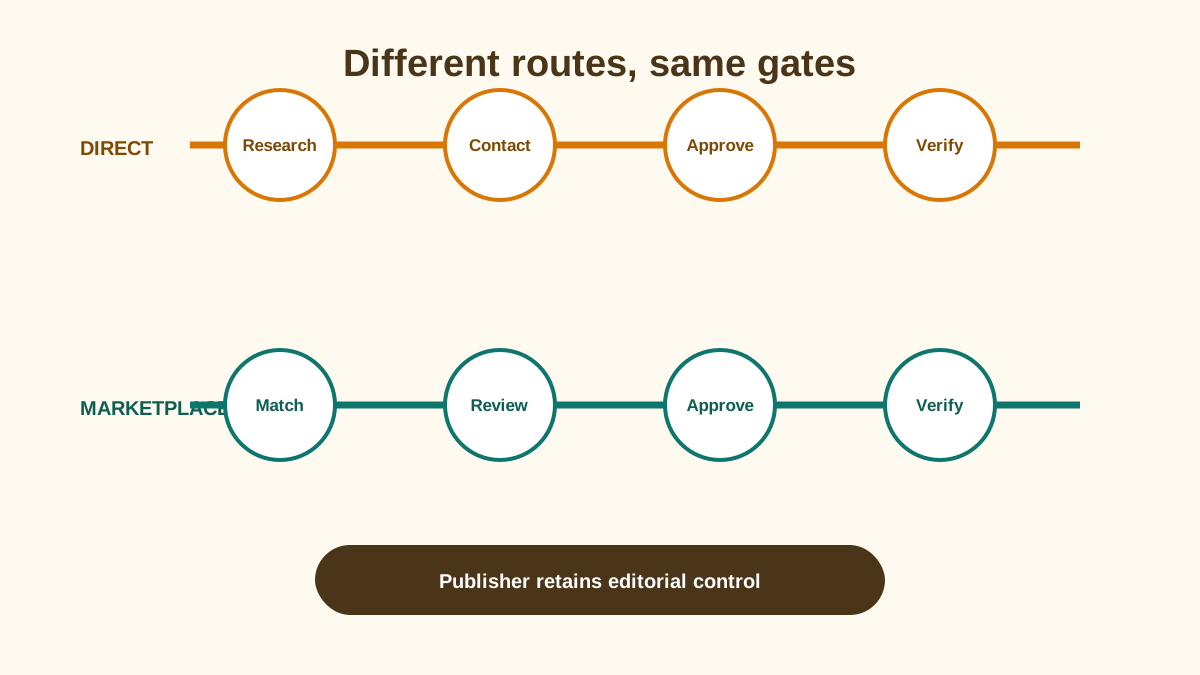
Both routes still require relevance, approval and public verification.
Marketplace: advantages
A marketplace can reduce repeated contact discovery and provide a shared workflow for advertisers and publishers that have chosen to participate. Opportunity fields, evidence and price can be reviewed in a consistent format.
Linkpool is designed around AI-assisted matching between campaign keywords and publisher content, followed by human review and approval. Matching is a discovery aid, not an editorial decision. The advertiser should inspect the source article and destination; the publisher retains control over whether and how a reference fits.
Centralized status can also improve handoffs. A teammate can see whether an opportunity is proposed, approved, awaiting publication or verified without reconstructing several email threads.
Marketplace: limits
Inventory is never the whole web. A campaign may find no eligible placement when its topic, budget or evidence requirements do not match participating publishers. The system should report that gap honestly rather than present an irrelevant result.
Standard fields can improve comparison but cannot replace reading. A high traffic total may belong to another section of the site. A relevant domain may contain a proposed article with no meaningful connection to the destination.
Commercial terms, publisher share, payment handling and dispute procedures must be understood before purchase. Review the current platform terms rather than assuming every marketplace uses the same model.
Compare price with total effort
For direct outreach, include prospecting time, data tools, email infrastructure, writing, follow-up, negotiation, editorial review, payment administration and later monitoring. Divide the total effort by accepted, verified placements—not the number of messages sent.
For a marketplace, include the accepted placement price, platform commission or fees, internal review time and any payment-processing terms. The link insertion pricing guide explains why article relevance, page evidence, authority, editorial work and commercial terms should be considered together.
A cheaper quote is not automatically better. An unclear duration, weak article fit or inaccessible destination can create more work than a higher-quality opportunity with precise terms.
Editorial control and disclosure
The publisher should be able to approve, revise or reject the proposed wording in both workflows. The advertiser can confirm that the destination is described accurately, but it should not require claims the source article cannot support.
Paid relationships should follow the publisher's policy and applicable search-platform guidance. Google recommends appropriate qualification for paid links. Do not ask a publisher to remove commercial treatment as a condition of payment.
Record the final public sentence and link attributes. A draft screenshot does not prove what readers received.
Verification and maintenance
After publication, open the public source while signed out. Confirm the article, context, anchor, destination and agreed commercial treatment. Follow redirects and make sure the final page still provides what the wording promises.
Save the baseline and choose a review cadence with a reason. The guide to monitoring a live placement describes how to record access, destination and wording changes without confusing maintenance with ranking attribution.
Direct outreach teams need to create this system themselves. A marketplace may centralize parts of delivery and status, but the buyer and publisher should still understand what has actually been checked.
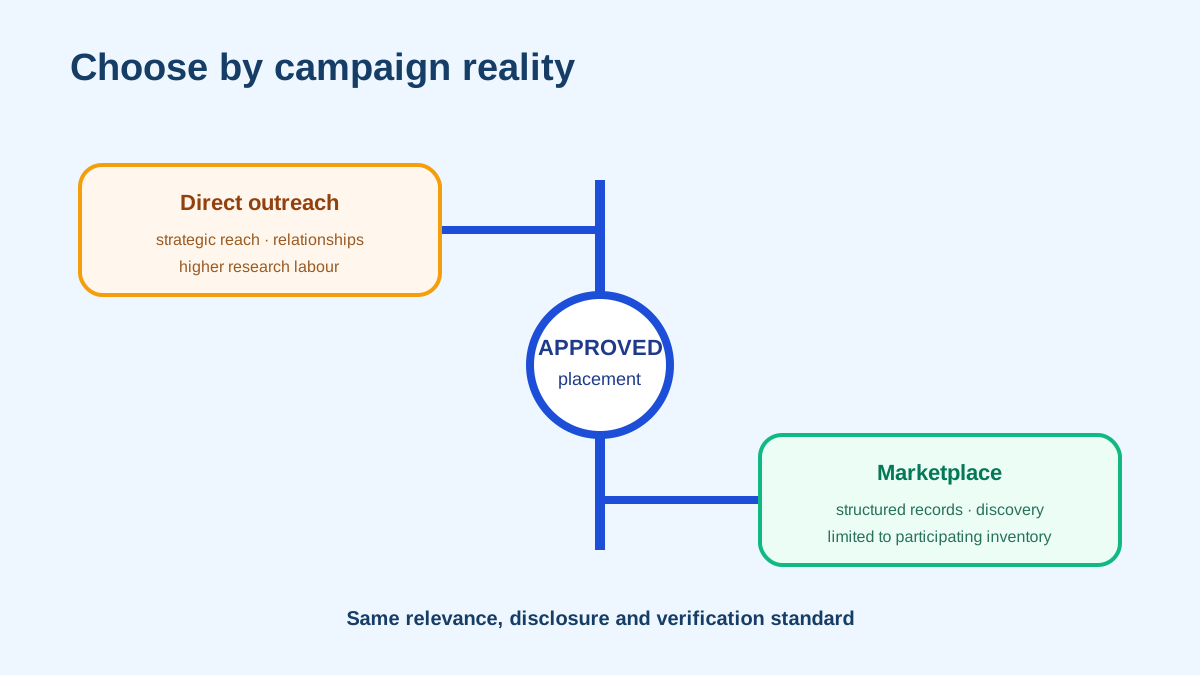
Select the workflow that improves evidence and follow-through for the campaign.
A practical hybrid model
Reserve direct outreach for a short list of strategic publications where relationship value and a tailored editorial conversation justify the work. Use a marketplace to review participating publishers through consistent opportunity records.
Keep one campaign brief and one approval standard across both channels. Do not lower the relevance threshold because an opportunity is convenient, and do not assume a personal reply makes a placement editorially strong.
Track comparable outcomes: accepted source URL, destination, wording, evidence, price, publication date, public verification and maintenance status. This reveals which route works for the campaign without treating message volume or marketplace inventory as success.
Final recommendation
Choose direct outreach for targeted relationship building and access beyond a platform's inventory when your team can research and manage the process responsibly. Choose a marketplace for structured discovery, comparison and fulfilment among participating publishers.
Use both when they serve different parts of the campaign. In every case, approve the article-to-destination fit, preserve publisher control, document commercial treatment and verify the public result. The process is successful when the reference is useful and the delivery record is clear—not when a dashboard or inbox contains more activity.
Frequently asked questions
Is a backlink marketplace faster than direct outreach?
It can reduce contact discovery and organize participating opportunities, but the review, approval and publication time depends on fit, evidence and publisher response.
Does direct outreach produce better links?
Not automatically. It can reach strategic publications and build relationships, but each source article and destination still needs the same editorial review.
Can I use both methods?
Yes. Use one campaign brief and approval standard, then compare verified outcomes and total effort across the two channels.
Does either method guarantee rankings?
No. A placement can be assessed for relevance, evidence and delivery, but search performance depends on many factors and should not be guaranteed.