
Contextual Link Placement Checklist: What to Approve Before Buying
Before approving a contextual link placement, review the source article, the destination page, the proposed sentence, and the commercial terms together. A domain score or low quote cannot tell you whether the placement helps a reader. The strongest approval process produces a small evidence record that both agency and publisher can understand.
This checklist is for agencies evaluating individual opportunities and publishers deciding whether to accept them. A backlink marketplace can organize that exchange, but the editorial decision still depends on the actual pages and agreed terms.
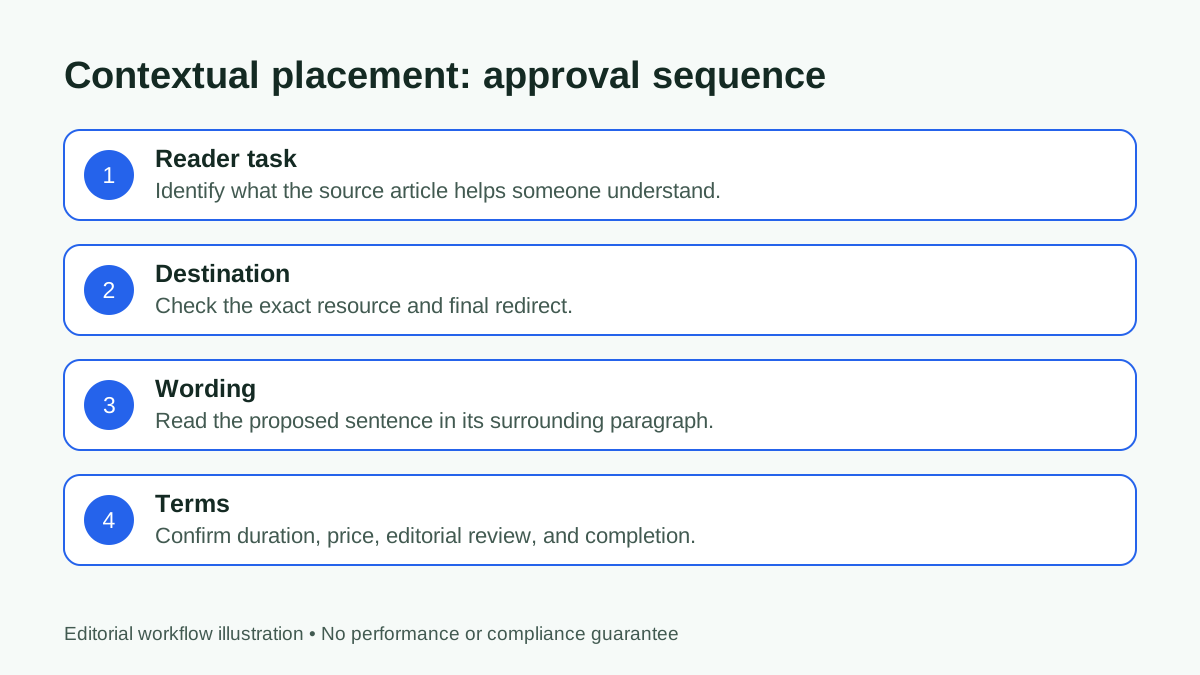
Start with the reader and the article before comparing prices.
Read the source article in full
Open the exact URL proposed for the placement. Check its current title, publication context, main subject, and the section where a reference would appear. An article that mentions a keyword once is not necessarily relevant to the campaign.
Ask what someone reading that section is trying to learn. A restaurant-menu comparison may support a useful menu-building tool. An unrelated lifestyle article containing the word “restaurant” may not. Our guide to high-quality contextual placements explains that distinction.
Check whether the page is a coherent editorial resource or a collection of disconnected commercial references. Read several surrounding paragraphs rather than evaluating one sentence in isolation. If the proposed insertion needs a large change in subject, it may belong in a different article.
Review the destination as a reader would
Open the final landing page, including any redirects. Confirm that it provides the promised information, tool, service, or evidence. Check it while signed out and on a phone.
A destination can be relevant in principle and still unsuitable in practice. An expired offer, inaccessible document, misleading headline, or page that asks for payment before showing a supposedly free resource changes the editorial value. The publisher should know what readers will encounter after tapping.
Record the destination's current owner and purpose. If the campaign later changes the target to a different business or topic, the original approval may no longer be valid. Agree how material destination changes will be handled rather than assuming the publisher has approved every future redirect.
Test the proposed sentence without the link
Read the sentence as plain text. Does it make sense in the paragraph? Does it add something the article needs? Would the publisher keep it if there were no commercial request?
Then inspect the anchor. It should describe the destination in ordinary language, with enough context to explain why the resource appears. Avoid forcing several sales keywords into one phrase.
Google's link best-practices documentation recommends descriptive anchor text and useful surrounding context. The practical editorial test remains straightforward: a reader should understand what following the reference will provide.
Separate the evidence into useful layers
Use page-level evidence to evaluate the article and site-level evidence to understand the wider publication. They answer different questions.
| Evidence | Question it can help answer |
|---|---|
| Article topic and surrounding text | Does the reference fit the reader's task? |
| Page-level search clicks and impressions | Has this particular URL received search visibility? |
| Site traffic and audience mix | Is the wider publication relevant to the intended audience? |
| Third-party authority metrics | How does the domain compare within that metric's system? |
| Agreed placement terms | What exactly will each party deliver? |
The guide to reading Google Search Console traffic covers the limits of clicks, impressions, CTR, and average position. None of these measurements guarantees referral traffic, indexing, or a ranking outcome for the advertiser.
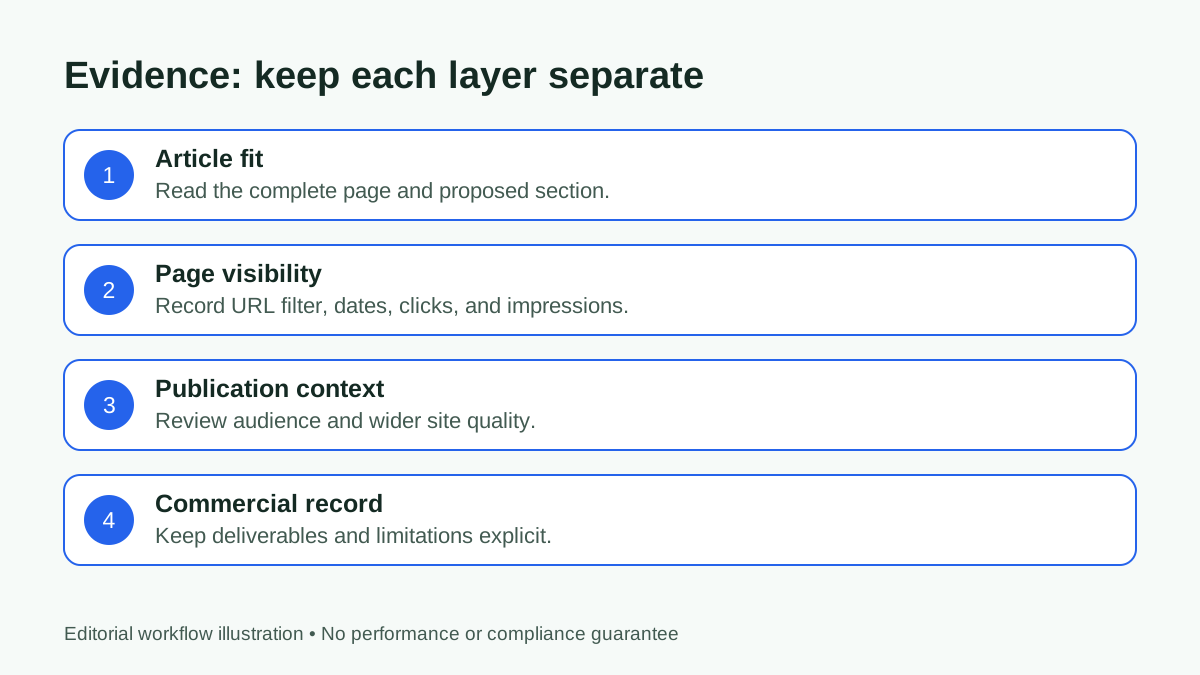
Keep article evidence separate from domain summaries and commercial promises.
Check dates, scope, and ownership of traffic data
When a publisher shares search data, record the property, date range, URL filter, and whether the figures describe the article or the whole domain. Two reports with different scopes should not be presented as a like-for-like comparison.
A recent 28-day period can show current activity, while a longer view can reveal whether that activity is unusual. If the figures are stale or incomplete, label them accordingly. Missing data is uncertainty to investigate, not proof that the article has no value.
Do not reconstruct exact performance from an authority score or a screenshot lacking a date range. Ask for the evidence that supports the claim. Use only data shared through an authorized workflow and keep sensitive account details out of campaign briefs.
Agree on the deliverable before the price
Describe the accepted source URL, destination URL, proposed anchor, surrounding wording, placement location, and expected duration. Identify which parts the publisher can edit for tone and accuracy.
Also agree on verification. A screenshot can support the record, but the final reference should be checked on the public page. The agency needs to know when completion is reported and what happens if the page or link becomes unavailable.
The contextual placement workflow guide explains the broader sequence from opportunity to publication. An approval checklist makes that sequence reviewable before either party commits.
Make commercial disclosure explicit
Paid references should follow the publisher's editorial policy and applicable platform rules. Google recommends qualifying advertisements and paid placements with the sponsored link attribute; its outbound-link guidance also explains other qualification values.
Do not promise a particular search benefit from a link attribute, and do not ask a publisher to conceal a commercial relationship. Confirm the intended treatment during approval so the final implementation is predictable.
Editorial fit and transparent treatment belong in the same decision. A relevant reference can still be commercially arranged, and a disclosure does not excuse an irrelevant insertion.
Review the total quote and the publisher share
Compare the total amount against the campaign's actual budget and the accepted deliverable. A low headline price can be difficult to assess when duration, maintenance, wording, or verification remains unclear.
Linkpool's current model allocates 80% of an accepted placement amount to publisher earnings and 20% to platform commission. For a $100 accepted placement, that allocation is $80 and $20 respectively. This illustration describes the marketplace allocation; payment-processing costs or other applicable terms must be checked separately.
Use the link insertion pricing guide to frame the article's value. Do not treat a suggested midpoint, market average, or traffic-based recommendation as a guaranteed fair price for every page.
Preserve the publisher's editorial control
The publisher should be able to approve, edit, counter, or decline. An agency's suggested sentence is a proposal, not an instruction to overwrite the publication's voice.
Record the accepted version. If edits materially change the destination's meaning or remove important context, return to review instead of silently treating the change as approved. Keep the exchange focused on the exact opportunity rather than an open-ended permission to add links anywhere on the site.
The guide to writing backlink outreach emails provides a useful model for presenting that request clearly.
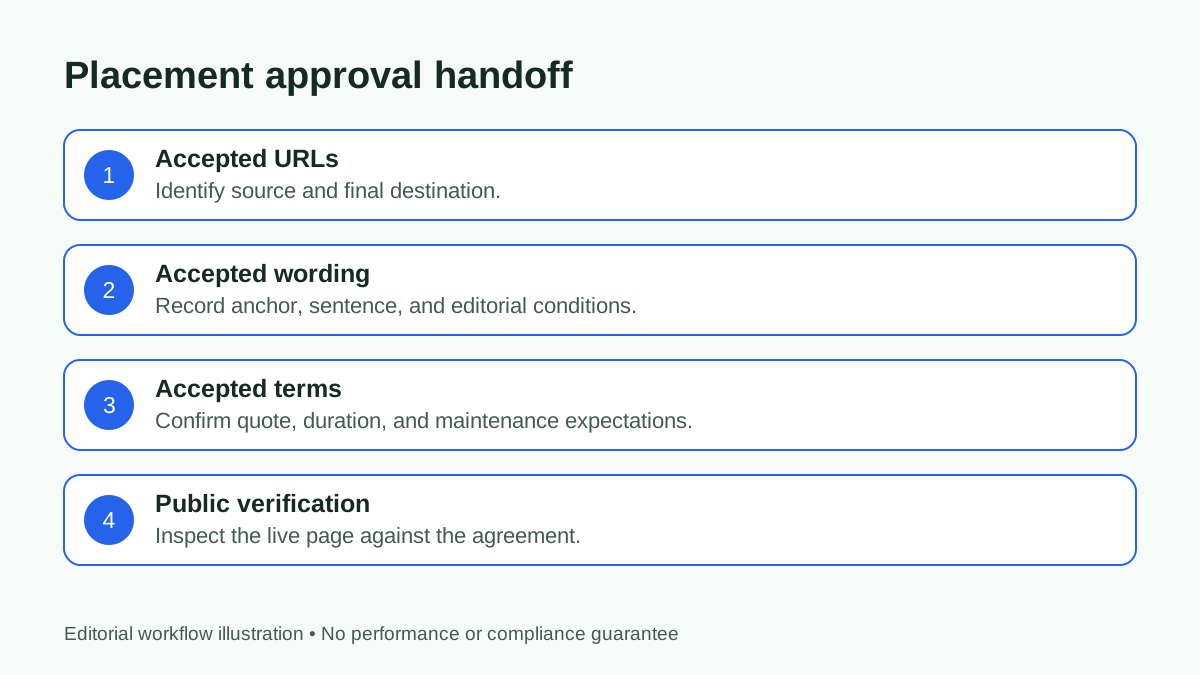
The handoff should describe what was approved and how completion will be checked.
Use three approval outcomes
Approve when the reference fits, the evidence is understandable, and the terms are clear. Request changes when the opportunity is useful but wording or scope needs correction. Decline when the source article or destination does not support the reader's task.
Do not use an approval status to conceal unresolved conditions. A conditional agreement should say which condition remains, who owns it, and what evidence closes it. That small discipline prevents an attractive shortlist from turning into a collection of ambiguous purchases.
FAQ
Is domain authority enough to approve a placement?
No. Read the source article and destination, then assess page-level evidence and terms. A domain metric is supporting context.
What if there is no page-level traffic report?
Record the limitation and review other evidence. Do not invent traffic or assume a domain total belongs to the proposed article.
Should an agency dictate the final anchor?
Suggest accurate wording, but preserve publisher review. The accepted anchor must read naturally and describe the destination.
What proves a placement is complete?
A publicly accessible source page containing the agreed reference, checked against the accepted URLs, wording, location, and terms. A status label alone is insufficient.