
Linkpool vs Getfluence: Which Editorial Placement Workflow Fits?
Linkpool is a backlink marketplace organised around matching campaign context with relevant publisher articles for both sides to review. Getfluence describes a broader off-site content activation platform with a large media catalogue, sponsored content, backlink placements, managed services and AI-visibility formats. Both can reduce manual prospecting, but they begin from different units of work and create different approval responsibilities.
The useful question is not which platform has the largest inventory or the newest AI label. It is which workflow lets your team find an appropriate page, preserve publisher control, understand the commercial terms and verify what became public. Product claims, counts, prices and guarantees can change, so record the page and date used for every buying decision.
Compare the evidence and approval path, not only the catalogue.
Quick recommendation
Choose Linkpool when you want article-level matching, publisher acceptance or counteroffers and a workflow centred on verifying an agreed contextual reference. Choose Getfluence when you want to browse or commission across a broad international media network and may need sponsored articles, managed execution or formats promoted for off-site SEO and AI visibility.
Neither route makes a placement automatically useful. Before opening either platform, define the destination, intended reader, acceptable subjects, excluded categories, geography, language, disclosure policy, budget and approval owner. The platform should narrow work inside those boundaries.
For a fair trial, use the same destination and campaign brief. Review a fixed number of candidates, record why each survives or fails, and compare the public results rather than comparing screenshots of the discovery interface.
Compare the unit of discovery
Linkpool starts with campaign context and existing publisher content. The proposed opportunity is closer to a particular article, so a reviewer can inspect the source page, its subject, freshness and surrounding section before the publisher decides. A match is still a suggestion, not permission to insert a link.
Getfluence presents a larger media-oriented catalogue and multiple content activation formats. Its current official site describes access to vetted media, marketplace and managed options, sponsored articles, backlinks, reporting integrations and formats intended for AI mentions. Confirm which exact publication, page type and deliverable are available in the account and region being tested.
A domain name or authority score is not the final placement. Ask whether you are approving an existing article, a future article, a sponsored feature, a link insertion or another defined format. The closer the evidence is to the final public page, the easier it is to judge reader value.
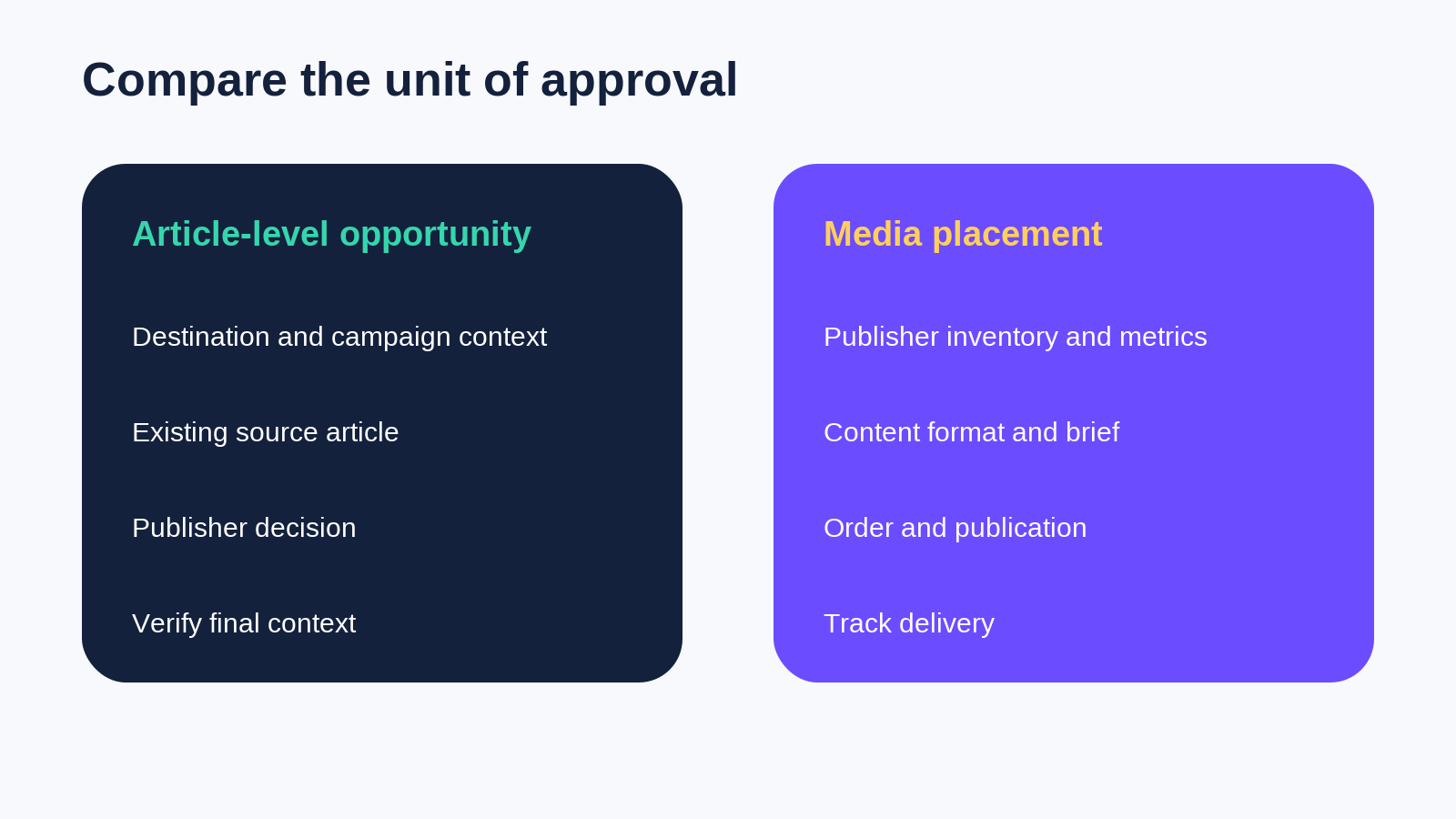
The approval unit determines what can be checked before money and content move.
Review publisher control and editorial responsibility
In Linkpool, the publisher should be able to accept, counter or reject a proposed opportunity. The final sentence must belong in the article, accurately describe the destination and follow the publisher’s editorial and commercial policies. An advertiser’s preferred anchor is a request, not an instruction to weaken the page.
Getfluence supports content placements across third-party media. For each format, confirm who writes, who edits, who approves the brief, whether the publisher can change the copy, how corrections work and which disclosure or link attributes apply. A managed service may reduce coordination for the buyer, but it does not remove the publisher’s responsibility for its page.
Use the contextual placement approval checklist on every candidate. It asks the same questions regardless of platform: Is the source useful? Does the destination answer the reader’s next question? Is the sentence accurate? Are the terms transparent? Can the delivery be checked publicly?
Separate media metrics from page relevance
Getfluence’s current marketing describes integrations with sources such as Google Search Console, Semrush, Majestic, Moz and Similarweb. Those signals can help screen inventory, but each has a different scope, methodology and refresh date. Record the provider and date instead of combining them into a single impression of quality.
Linkpool can surface publisher-connected Search Console evidence when available. First-party clicks and impressions can help establish that a property or URL prefix has received search activity during a stated period. They do not forecast traffic, rankings, leads or sales from a new placement.
Open the actual site. Review topic consistency, author information, disclosure, recent publication quality, outbound-link patterns, accessibility and whether the candidate page serves the intended reader. A strong domain metric cannot make an unrelated paragraph relevant.
Compare content formats without blending promises
Getfluence’s official site currently presents sponsored articles, backlink marketplace options and formats marketed for AI visibility. Each format should have its own brief, price, content owner, review process, publication expectation and reporting method. Do not transfer a guarantee or turnaround claim from one product to another.
Linkpool focuses on contextual opportunities connected to publisher content. That can make the final placement easier to inspect, but it still requires a useful sentence, a suitable destination and explicit commercial agreement. Confirm the expected duration, payment release and procedure if the public result differs from the approved context.
If a platform describes placements as suitable for GEO or AI visibility, treat that as a use case to evaluate, not a guaranteed outcome. AI systems change their retrieval, citation and answer behaviour. A useful, accurate article on a credible site may support discoverability, but no single placement should be presented as certain to produce mentions.
Normalize price and operational effort
Record the exact quoted price, currency, taxes, commission, writing or editing fee, revisions, publication duration, replacement terms and monitoring responsibility. Add internal time for research, approval, communication, copy review and evidence storage. A low placement price can be expensive when unsuitable candidates consume hours.
Getfluence says its marketplace can be used without a subscription or minimum commitment and describes pay-per-placement access, while managed services may follow different commercial terms. Verify the current account screen and contract rather than relying on a general landing page.
Linkpool records the proposed commercial terms around an opportunity and lets the publisher make a decision. Before approval, confirm what the advertiser pays, what the publisher receives, when funds are released and what evidence closes the request. The link insertion pricing guide explains why relevance, editorial work and maintenance belong in the cost comparison.
Build an evidence record before approval
Save the campaign brief, destination URL, source page, proposed section, full sentence, anchor, price, duration, disclosure treatment, approvers and date. For future articles, add the agreed topic, content owner, revision rights and deadline. A dashboard status is useful, but it should not be the only delivery record.
Review evidence in layers: audience fit, page quality, commercial terms and public verification. Reject a candidate when the broad topic matches but the specific article does not. Reject wording that exaggerates the destination or reads like an unsupported endorsement.
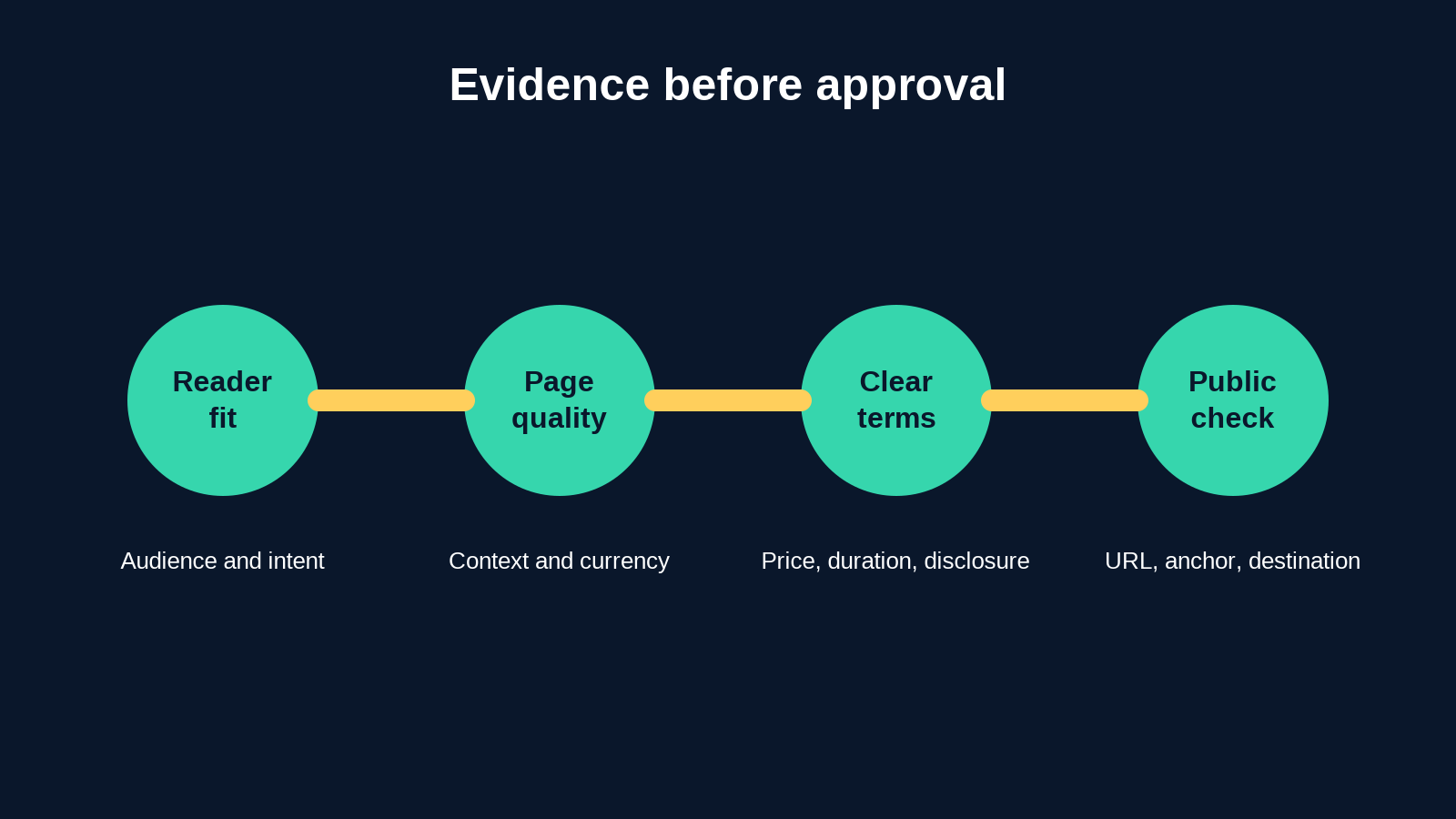
Approval should leave enough evidence for another person to understand the decision.
Verify the live result while signed out
Open the final public URL without an account. Confirm the article is accessible, the surrounding text matches the approved meaning, the anchor is accurate, the destination resolves correctly and the expected commercial treatment is present. Store the URL and verification time.
If the placement is part of a new article, read the complete page rather than jumping directly to the link. Check that the headline, byline, publication date and main content are genuine and coherent. A reference can be technically present inside a weak or unrelated article.
Use the post-publication monitoring workflow to record later access, destination, wording or disclosure changes. Indexing is a separate observation from public availability, and neither alone proves business impact.
Run a controlled agency pilot
Create one brief with a real destination and a defined reader. Review ten candidates in each platform, or another equal sample your team can realistically inspect. Predefine rejection reasons so the evaluator does not move the standard after seeing the inventory.
Measure time to a suitable candidate, page-level relevance, price clarity, publisher communication, revision effort, evidence quality and verified public delivery. Also count candidates rejected after manual review. A platform that returns fewer but more suitable pages may reduce total work.
After publication, ask whether a colleague can locate the approved context, commercial terms and next review date without relying on the original operator’s memory. Operational clarity becomes more important as an agency adds clients and markets.
Final recommendation
Linkpool fits teams that want campaign-to-article matching, visible publisher decisions and a verification-led contextual workflow. Getfluence fits teams that need broad media access, multiple placement formats and optional managed execution across markets.
The platforms can overlap, but they should not be evaluated as identical catalogues. Choose the one whose unit of discovery, editorial controls, commercial record and verification process match the campaign. Keep human review at the page and sentence level regardless of how quickly automation finds an option.
Do not promise rankings, traffic, AI mentions or revenue from a placement. The defensible result is a relevant, accurate and transparently handled reference that can be checked after publication.
Frequently asked questions
Is Getfluence only a backlink marketplace?
No. Its current official positioning describes a broader off-site content activation platform with media discovery, sponsored content, backlink placements, managed services and AI-visibility formats. Verify the exact product and terms in the account.
Does Linkpool automatically approve placements?
No. Matching can identify a possible article-level opportunity, but advertisers and publishers still review the context and terms. The publisher retains the decision to accept, counter or reject.
Which platform is better for international campaigns?
Getfluence publicly emphasises a broad international media network. Availability, language, format, price and editorial standards still need to be checked for each publication. Linkpool may fit when article-level contextual matching is the priority.
Can either platform guarantee SEO or AI visibility?
No comparison should promise a ranking, traffic or AI-citation result from one placement. Evaluate relevance, transparency, public delivery and the evidence you can maintain over time.